You spend hours crafting the perfect email. The subject line is sharp. The copy is clean. The offer is solid. Then you schedule it for Tuesday at 10 a.m. because some blog post from 2019 told you that’s when people check their inbox.
Here’s the uncomfortable truth: that Tuesday 10 a.m. advice was never right for everyone. It was an industry average, calculated from millions of sends across thousands of different audiences, industries, and timezones. Your subscribers have their own habits, their own routines, and their own moments of inbox-opening.
If you’re a blogger, small business owner, or online entrepreneur, you could be sending to the right people with the right message, and still watching your open rates stay flat because you hit their inbox when they’re in a meeting, on a call, or half-asleep.
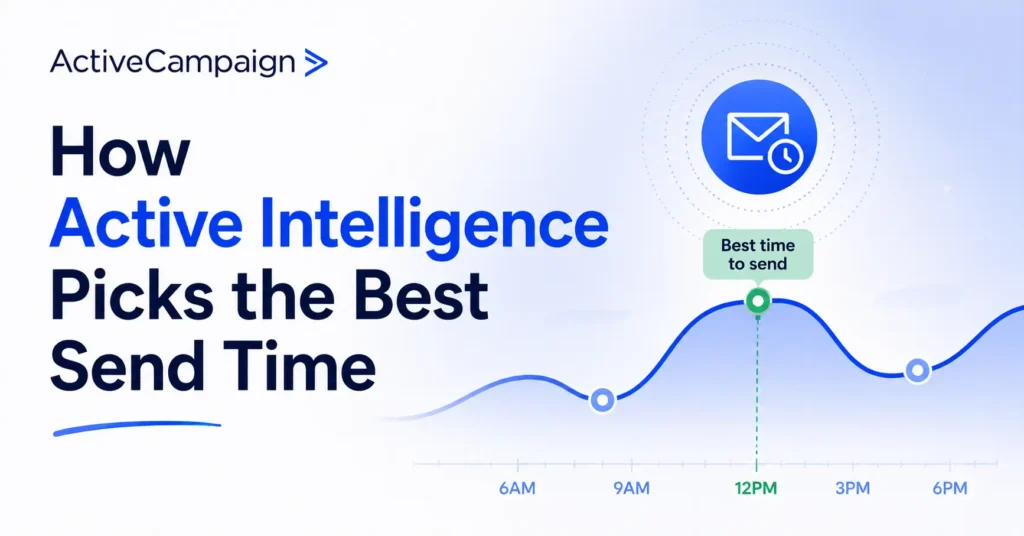
That’s the problem ActiveCampaign’s Predictive Sending feature was built to solve. Powered by Active Intelligence, the platform’s built-in AI co-pilot, Predictive Sending doesn’t guess at the best send time. It calculates one per contact, based on real behavioral data. The results speak for themselves: an average 17% higher click-through rate compared to standard broadcast sending.
In this article, we’ll break down exactly how it works, what data it uses, who benefits most, and whether it’s worth turning on for your list. No fluff. Just a genuine deep-dive from someone who cares about making email work harder for you.
Why “Best Time to Send” Is a Myth (And What Is Actually True)
Let’s start with why the problem exists at all.
The “best time to send emails” debate has been running for over a decade. Mailchimp says Tuesday. HubSpot says Thursday. Campaign Monitor says Wednesday morning. CoSchedule ran an analysis of 14 studies and concluded the data was all over the place.
The reason these studies disagree is simple: they’re averaging across wildly different audiences. A B2B SaaS company’s email list behaves nothing like a Shopify store’s list. A food blogger’s subscribers open emails differently than a law firm’s newsletter readers. Within any single list, individual behavior varies enormously.
Think about your own inbox behavior. Maybe you catch up on newsletters during your morning commute. Maybe you skim promotional emails on Sunday evenings when you’re planning the week. Maybe you never open anything sent after 3 p.m. on Fridays. Your subscribers have their own version of all this, and it is unique to each of them.
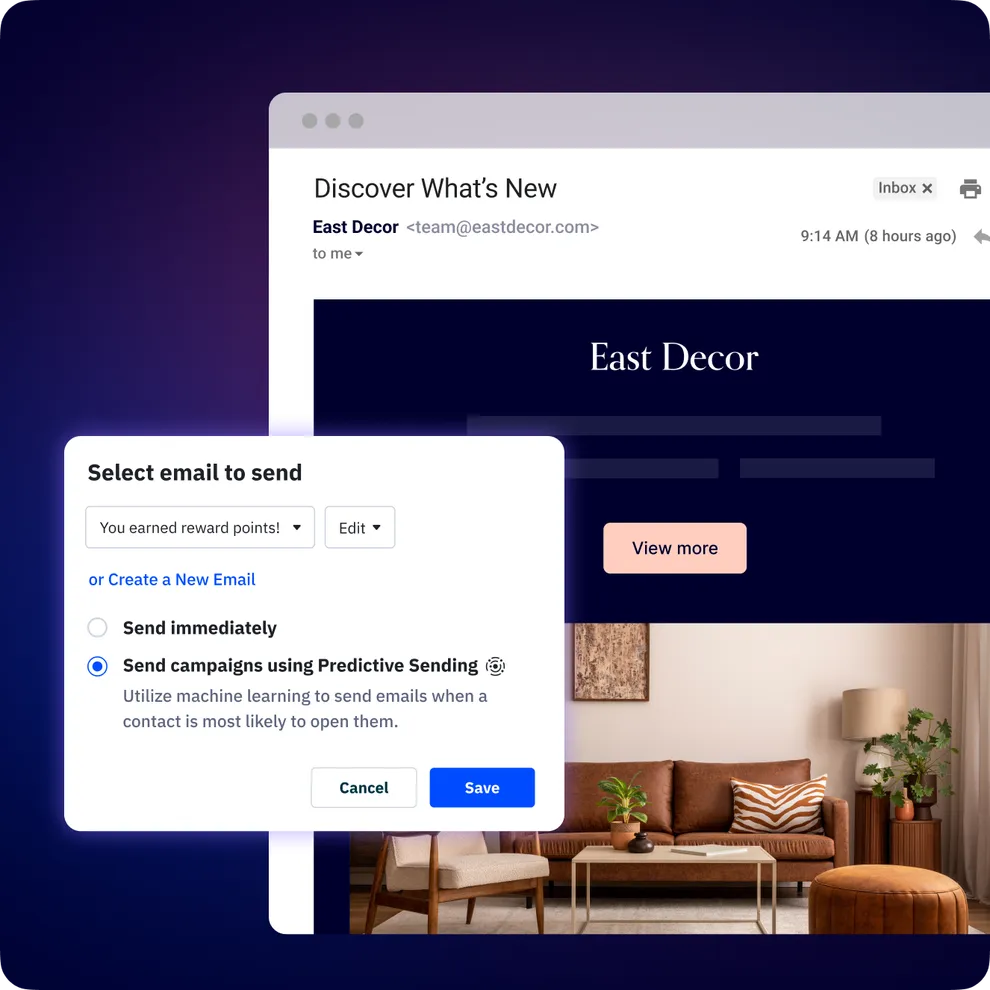
What Does “Best Time” Actually Mean at the Individual Level?
The question is not just “when is this person online?” It is more nuanced than that: “When does this specific person typically engage with email, and what type of email are they likely to open right now?”
That is a data problem. A big one. It requires machine learning to solve at scale. That is exactly what ActiveCampaign’s Active Intelligence is built to do.
What Is Predictive Sending? (A Plain-English Explanation)
Predictive Sending is a feature inside ActiveCampaign that automatically determines the optimal time to deliver an email to each individual contact on your list. It then holds and delivers that email at precisely that calculated moment.
It is not a broadcast feature. You do not set one send time and blast your whole list. When you turn on Predictive Sending for a campaign, ActiveCampaign’s Active Intelligence engine analyzes each contact’s historical engagement data, calculates a personalized delivery window, and queues up each email to go out at that person’s optimal time.
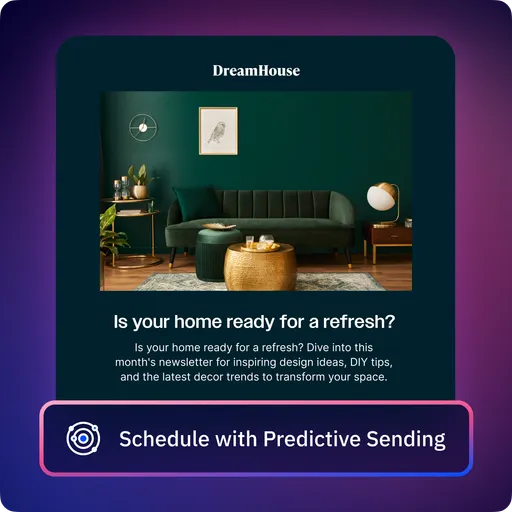
Predictive Sending vs. Traditional Send Time Scheduling
Here is a concrete comparison of what that means in practice:
| Traditional Broadcast | Predictive Sending |
| You pick one time (e.g., Tuesday 10 a.m.) for your entire list | Each contact gets their email at their personal optimal time |
| Based on industry averages or your last campaign’s performance | Based on that specific contact’s engagement history |
| Works at the list level: a good average, not a great individual match | Works at the contact level: right time for the right person |
| Requires manual testing and adjustment over time | Adapts automatically as the model learns more about each contact |
| One send = one timestamp across all recipients | One campaign = thousands of personalized delivery windows |
This distinction matters a lot. Most email platforms let you schedule sends. A few let you A/B test send times. ActiveCampaign’s Predictive Sending goes further. It removes the manual decision entirely and replaces it with individual-level machine intelligence.
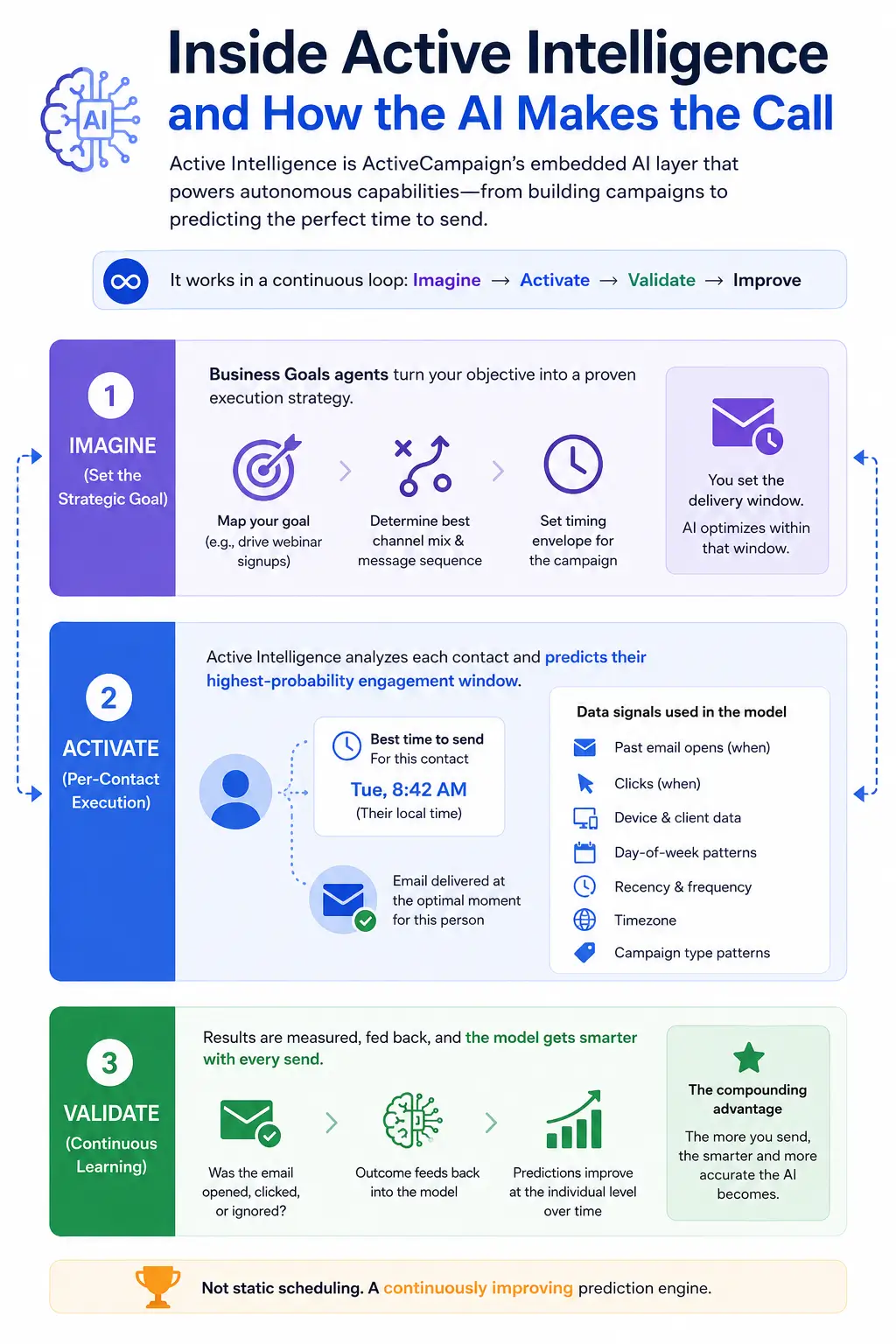
Inside Active Intelligence and How the AI Makes the Call
Active Intelligence is ActiveCampaign’s embedded AI layer. Think of it as the brain that powers the platform’s autonomous capabilities, from building complete campaigns via a single prompt to generating segmented audiences to optimizing send times.
Understanding how it makes timing decisions requires understanding the broader framework it operates within. ActiveCampaign calls this the Imagine, Activate, and Validate loop.
Phase 1: Imagine (Setting the Strategic Goal)
At the Imagine phase, Business Goals agents take your marketing objective, whether that is “drive webinar signups” or “recover abandoned carts”, and map it to proven execution strategies. This includes determining the optimal channel mix, message sequencing, and timing parameters for your campaign type.
For email specifically, this phase sets the envelope: a delivery window within which Predictive Sending will operate. You are not surrendering control. You are setting the parameters within which the AI optimizes.
Phase 2: Activate (Per-Contact Execution)
This is where Predictive Sending does its work. The Active Intelligence engine pulls individual contact-level data and runs it through a predictive model to determine the highest-probability engagement window for each recipient.
What data goes into the model? While ActiveCampaign does not publish the exact feature weights of its ML model (no platform does), the behavioral signals that feed into send-time optimization engines of this type include:
- Past email open timestamps: when has this contact historically opened emails?
- Click timestamps: when did they engage beyond just opening?
- Device and client data: do they primarily read on mobile or desktop?
- Day-of-week patterns: are they a Monday-morning inbox cleaner or a Sunday-evening reader?
- Recency and frequency: how active are they right now compared to six months ago?
- Timezone: basic but critical, especially for international lists.
- Campaign type patterns: do they engage with promotional sends differently than newsletters?
The more history a contact has with your emails, the more confident and accurate the model’s prediction becomes. For brand-new contacts with no engagement history, Active Intelligence falls back on intelligent defaults derived from your audience’s aggregate behavior, essentially using your best-performing send windows as a starting point until individual data builds up.
Phase 3: Validate (Continuous Learning)
After delivery, Active Intelligence closes the loop. It logs whether the contact opened, clicked, or ignored the email at the predicted optimal time, then feeds that outcome back into the model. Over time, the predictions improve at the individual level.
This is the compounding advantage that most email platforms do not have. The system gets smarter with every campaign you send. It is not static scheduling. It is a continuously improving prediction engine.
The Real-World Numbers (What Predictive Sending Actually Delivers)
I do not like articles that throw stats around without context. So let’s break down what the numbers actually mean for a real email list.
The Headline Stat: 17% Higher Click-Through Rate
ActiveCampaign reports that campaigns using Predictive Sending see an average 17% higher click-through rate compared to the same type of campaigns sent without it. That is not a one-off result. It is an average across the platform’s customer base.
To put that in perspective: if your current click-through rate on a promotional campaign is 2.5%, Predictive Sending could realistically push that to 2.9%. That might not sound dramatic, but across a list of 10,000 subscribers, that is 40 more clicks per campaign. At even a modest 5% conversion rate from click to purchase, that is 2 additional sales per send. At scale, that compounds fast.
The Broader AI Timing and Segmentation Effect: 30% More Clicks
When you combine Predictive Sending with ActiveCampaign’s AI-Suggested Segments, which automatically surface the highest-engagement audiences for each campaign, the platform reports up to 30% more clicks compared to manually timed, manually segmented broadcasts.
That’s the key insight here: Predictive Sending works best as part of a stack, not in isolation. Right time plus right audience plus right message is the equation Active Intelligence is designed to solve end-to-end.
Customer Proof Points
Here is what real customers have achieved:
UBITS, an online education platform, achieved a 10.8% click-through rate after activating ActiveCampaign’s AI segmentation and timing features. Their previous CTR was 2.92%. That is a 270% improvement in click engagement.
MyMDAdvocate saw their email open rate jump from 4% to 67% after moving to ActiveCampaign and activating targeted email features. A 4% open rate is essentially invisible. A 67% open rate means your message is actually landing.
Parrish Law went from open rates of 17 to 19% to consistently hitting 35 to 40% using ActiveCampaign’s AI reporting and send optimization tools. For a professional services firm where every client relationship matters, this translated directly to more consultations booked.
YMCA of Alexandria achieved a 12.8% click-through rate, compared to a 2% industry average, while also saving 10 or more hours weekly on campaign management thanks to Active Intelligence.
These are not cherry-picked outliers. They represent a consistent pattern: when you stop guessing at timing and let the AI optimize it, engagement goes up. The only variable is how much, and that depends on how active your list is and how much engagement history the model has to work with.
How to Enable Predictive Sending in ActiveCampaign (Step-by-Step)
Turning on Predictive Sending is straightforward. Here is exactly how to do it inside your ActiveCampaign account:
- Create or open a campaign in your ActiveCampaign dashboard.
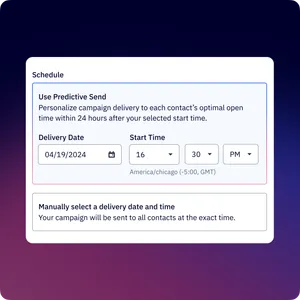
- Proceed through the campaign setup until you reach the Schedule step, which is the final step before sending.
- Instead of selecting a fixed date and time, look for the Predictive Sending or “Send at the optimal time” toggle.
- Enable the toggle. ActiveCampaign will display a delivery window (for example, “within the next 24 hours”). The AI will deliver each contact’s email within that window at their predicted optimal time.
- Confirm and schedule. You will still set a campaign start date, but the exact delivery time per contact is handled automatically.
One thing worth noting: Predictive Sending works best on lists with at least a few hundred active contacts who have previous engagement history with your emails. On a brand-new list with zero engagement data, the model uses aggregate defaults. Still useful, but the per-contact precision develops as your list matures.
Predictive Sending Is Part of Autonomous Marketing, Not Just a Standalone Feature
Here is where the conversation gets genuinely interesting. Most articles about Predictive Sending treat it as a scheduling tweak. It is actually much more than that.
Predictive Sending is one component inside a larger autonomous marketing stack that ActiveCampaign is building through Active Intelligence. Understanding how these pieces fit together is what separates marketers who get marginal gains from those who see transformational results.
The Autonomous Marketing Stack
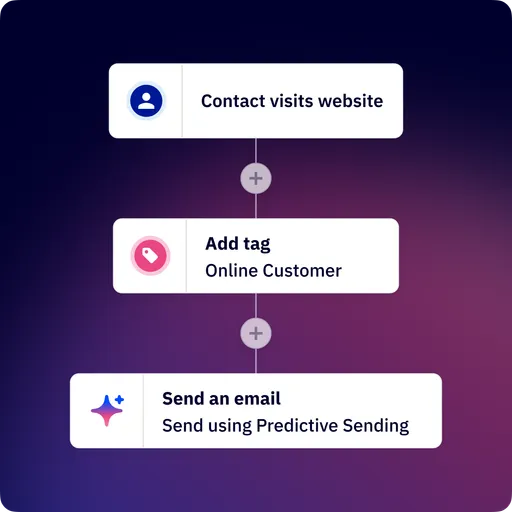
Active Intelligence bundles several AI-powered capabilities that build on each other:
AI Campaign Builder: Creates entire campaigns (subject line, body copy, CTA, segmentation) from a plain-language prompt. Customers report 8x faster campaign creation and 10 hours saved weekly.
AI-Suggested Segments: Automatically identifies which portion of your list is most likely to engage with a given campaign type. It works upstream of Predictive Sending. It selects who gets the email, and Predictive Sending optimizes when they get it.
Predictive Sending: Handles the timing layer, which is the optimization described throughout this article.
AI Content Generation: Produces and refines on-brand visuals and copy within campaigns, applied alongside your AI Brand Kit (colors, fonts, logos) automatically.
Business Goals: The strategic layer. You describe a goal in plain language, such as “get more webinar signups from cold leads”, and Active Intelligence maps the entire campaign strategy, including channel mix, sequencing, and timing parameters.
The reason this matters for Predictive Sending specifically: timing optimization is most powerful when the email content and audience are already optimized. A perfectly timed bad email is still a bad email. But a well-crafted, well-segmented email delivered at each recipient’s peak engagement moment is a campaign that truly compounds.
ActiveCampaign reports that customers combining AI segmentation with timing optimization see 30% more clicks, not just 17%. That extra 13 percentage points comes from the stack effect, not from timing alone.
Predictive Sending vs. Manual Send Time Testing (An Honest Comparison)
Some marketers swear by A/B testing their send times. It is a legitimate approach. If you are not using any AI features, it is the right way to improve timing systematically. But let’s be honest about its limits.
| Factor | Manual A/B Testing | Predictive Sending (Active Intelligence) |
| Granularity | List-level average | Individual contact level |
| Adaptability | Static until next test | Continuously updates with every send |
| Time to insight | 2 to 4 weeks minimum | Immediate, improves over time |
| Setup effort | Medium: requires test design | Zero: just enable the toggle |
| Scale | Hard to scale beyond 2 to 3 time slots | Scales to entire list automatically |
| Accuracy ceiling | The best average you can find | The best time per individual |
The fundamental limitation of A/B testing send times is that you are still looking for the least bad average. If your list has 5,000 people and the winning send time is Tuesday 9 a.m., that is likely optimal for maybe 1,500 of them, and suboptimal for the other 3,500. Predictive Sending eliminates that problem by treating every contact as an individual rather than a data point in an average.
One real limitation to acknowledge: A/B testing gives you transparent, auditable data you can learn from. Predictive Sending is a black-box optimization. You trust the model. For some marketers, especially those who want to deeply understand their audience’s behavior, the lack of visibility into individual timing decisions can feel like ceding control. That is a reasonable concern, and it is worth weighing against the performance gains.
Who Gets the Most Value from Predictive Sending?
Predictive Sending is not equally valuable for every business. Here is an honest breakdown of who should prioritize it.
High-Value Use Cases
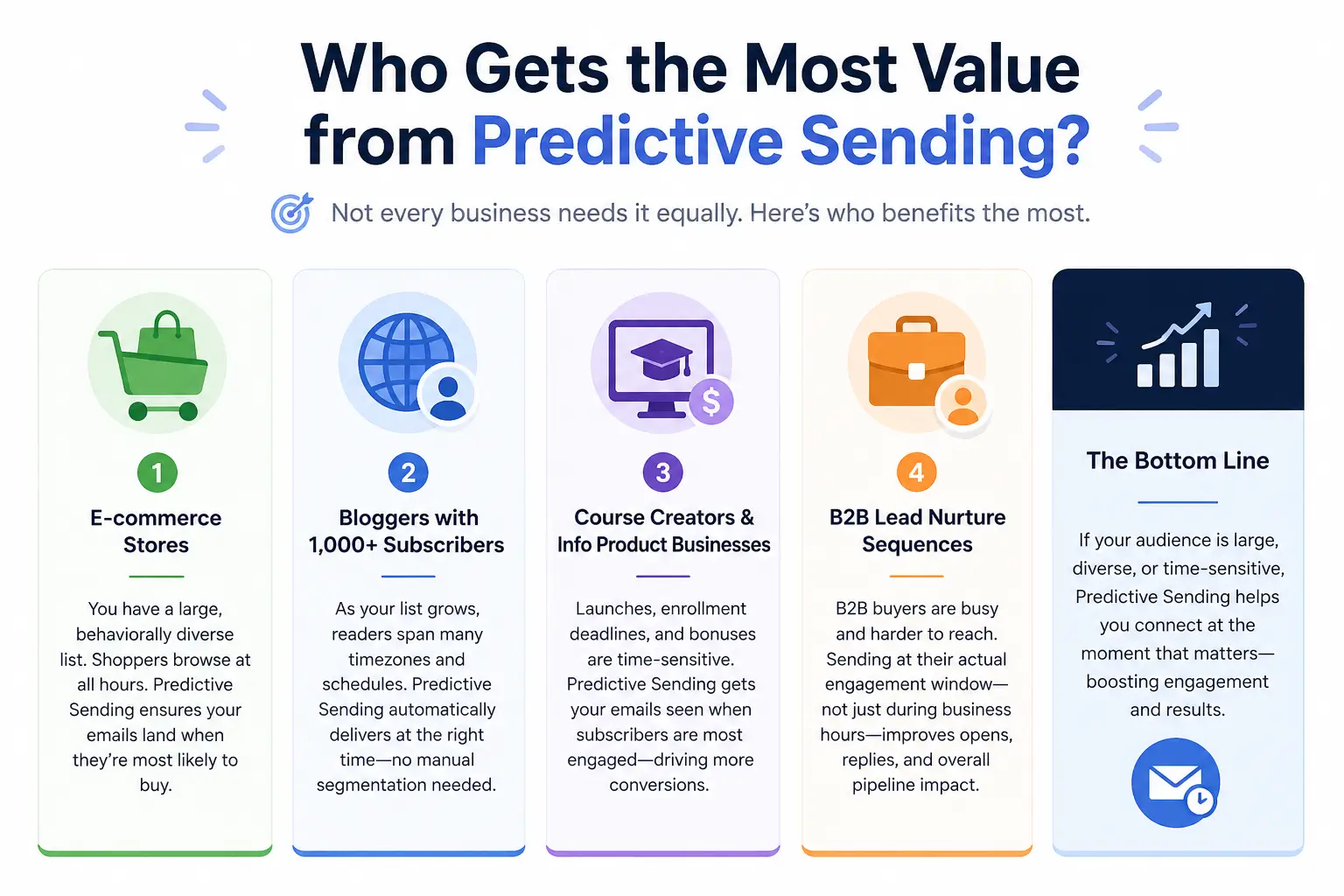
E-commerce stores: You have a large, behaviorally diverse list. Subscribers include early-morning shoppers, lunch-break browsers, and late-night deal hunters. A single send time misses most of them. Predictive Sending was practically designed for this use case.
Bloggers with 1,000 or more subscribers: As your list grows beyond a few hundred, the assumption that everyone reads on the same schedule breaks down fast. International readers alone can span 10 or more timezones. Predictive Sending handles this automatically without you building timezone-based segments by hand.
Course creators and info product businesses: Your email sequences often drive people toward time-sensitive purchases such as launch windows, enrollment deadlines, or bonus expirations. Getting these emails in front of subscribers when they are engaged, rather than buried in their inbox from a bad-timing send, is directly tied to revenue.
B2B lead nurture sequences: B2B buyers are typically harder to reach. They are in meetings, heads-down on projects, fielding dozens of emails daily. Hitting their inbox at their actual engagement window rather than your assumed business hours schedule makes a real difference in open and reply rates.
Lower Priority Use Cases
Very small lists (under 200 subscribers): The model has limited data to work with, so predictions are less precise. You will still get the aggregate defaults, but the individual-level advantage develops as your list grows.
Time-sensitive broadcasts such as breaking news or flash sales: If you need everyone to see your email within a one-hour window, Predictive Sending’s spread-out delivery is not appropriate. For true urgency, schedule a fixed broadcast.
My Honest Take (Is Predictive Sending Worth Turning On?)
Let me cut through the marketing language and give you a straight answer.
Predictive Sending is one of those features where the value proposition is real, the setup cost is essentially zero, and the downside risk is minimal. You are not restructuring your campaigns. You are toggling one option and letting the AI do the rest. At worst, it delivers your emails spread across a 24-hour window instead of all at once. At best, it consistently adds 15 to 30% more engagement to every campaign.
The 17% CTR improvement figure is not a marketing claim pulled from a single case study. It is an observed average across ActiveCampaign’s platform, which processes 150 million or more automated campaigns per month. That is a statistically meaningful number.
What I Would Actually Recommend
- If you are on ActiveCampaign already: turn it on today. There is no meaningful reason not to.
- If you are evaluating email platforms: Predictive Sending at the individual contact level is a genuine differentiator. Most platforms offer send-time optimization at the segment or audience level, not the individual level. That distinction matters for large, behaviorally diverse lists.
If you are not yet on ActiveCampaign: the 14-day free trial gives you enough time to set up a campaign, enable Predictive Sending, and see the delivery behavior firsthand.
Try ActiveCampaign free for 14 days. No credit card required.
Frequently Asked Questions
Does Predictive Sending work for new contacts with no engagement history?
Yes, but with reduced precision. For new contacts, Active Intelligence defaults to your audience’s aggregate best-performing send windows, essentially the optimal time for your list as a whole. Individual-level accuracy improves as the contact accumulates engagement history, typically after three to five campaign interactions.
Will my emails arrive at the same time if I use Predictive Sending?
No, and that is intentional. Rather than sending every email simultaneously, ActiveCampaign staggers delivery across your list based on each contact’s predicted optimal window. Your campaign report will show a spread of delivery times rather than a single timestamp. This is by design and is what makes the feature work.
Can I override Predictive Sending for a specific contact?
Not at the individual contact level. The timing is managed by the model, not manually adjusted per recipient. However, you can always disable Predictive Sending for a specific campaign and schedule a fixed broadcast time if you need synchronized delivery.
Is Predictive Sending available on all ActiveCampaign plans?
Predictive Sending is an Active Intelligence feature. Availability depends on your ActiveCampaign plan tier. As of 2026, AI features are included on Plus, Professional, and Enterprise plans. Check the current plan comparison page on ActiveCampaign’s site for the most up-to-date feature availability before purchasing.
How long before I see a meaningful improvement in click-through rates?
Most users see measurable differences within three to five campaigns as the model builds individual contact profiles. The compounding effect strengthens over two to three months of regular sending. If you are only sending monthly newsletters, give it three to four months before drawing conclusions.
Does Predictive Sending affect my email deliverability?
Predictive Sending does not directly impact deliverability. It controls delivery timing, not content or sender reputation. That said, higher engagement rates (opens and clicks) resulting from better-timed sends do signal to inbox providers that your emails are wanted, which can indirectly improve deliverability over time.
Does Predictive Sending work for automated sequences, not just one-off broadcasts?
ActiveCampaign’s Active Intelligence is designed for both campaign broadcasts and automation sequences. For drip sequences, the timing optimization applies within the configured delivery window. The AI determines the best moment within your allowed timeframe for each contact’s next email in the sequence.
What is the difference between Predictive Sending and timezone-based scheduling?
Timezone scheduling is table stakes. It sends at the same clock time across timezones. Predictive Sending goes further: it analyzes actual behavioral patterns to find the optimal engagement window, which may differ significantly from business hours even within the same timezone. Someone in New York might consistently open emails at 6:30 p.m., not 10 a.m. Timezone scheduling does not capture that. Predictive Sending does.
What happens if a contact has not opened any emails in several months?
For disengaged contacts, the model will have limited recent signal to work with. Active Intelligence will likely fall back to your audience aggregate defaults for those contacts. If re-engagement is a goal, ActiveCampaign’s AI-Suggested Segments can help you identify and separately target dormant subscribers with a tailored re-engagement sequence.
Can I use Predictive Sending alongside welcome email sequences?
Welcome sequences typically start immediately when someone subscribes, so there is little historical data for the model to use on day one. For your initial welcome email, a fixed send or a short delay rule usually makes more sense. Predictive Sending becomes more valuable from the second or third email onward, once the subscriber has at least one engagement data point in your account.
Conclusion
Email timing is a leverage point most marketers are leaving on the table. Not because they do not know it matters, but because optimizing it manually is genuinely difficult at scale. You cannot run an A/B test for every contact on your list. You cannot track every subscriber’s individual reading patterns by hand.
ActiveCampaign’s Active Intelligence can. Predictive Sending is the practical expression of that capability. It takes the per-contact behavioral data that lives inside your account and turns it into a delivery decision that is better than anything you would schedule manually.
The 17% average CTR improvement is not the ceiling. When you stack Predictive Sending with AI-suggested segments and an AI-built campaign, you are looking at 30% or more clicks from the same list, the same offer, and the same copy. The only thing that changed is the intelligence behind the delivery.
That is what autonomous marketing actually means in practice: not replacing the marketer, but eliminating the manual decisions a machine can make better. Send timing is one of those decisions.
If you are already on ActiveCampaign, enable Predictive Sending on your next campaign. If you are not yet using it, this might be the feature that makes the switch worth it.