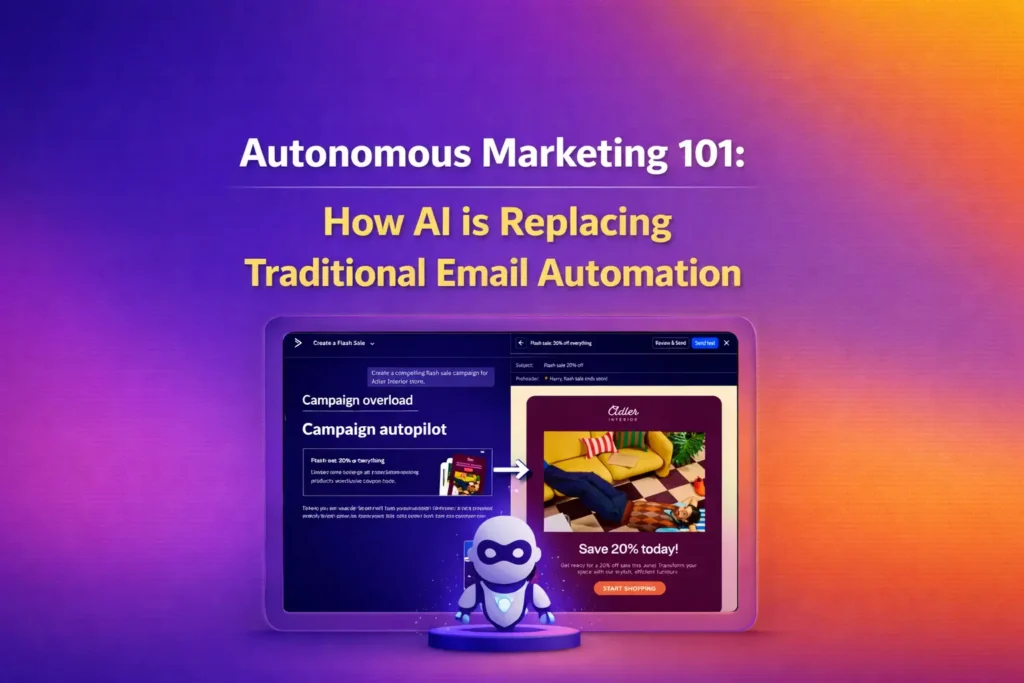
If you are a modern marketer or business owner, you likely feel like there are never enough hours in the day. Between analyzing data, building out complex email flows, writing copy, and analyzing segments, the modern digital marketer wastes an average of 13 hours per week purely on manual, repetitive tasks.
For the past decade, we believed “marketing automation” was the solution to this problem. We envisioned a world where software would handle the heavy lifting while we focused on strategy. But traditional marketing automation brought its own set of headaches: endless logic branches, confusing “If/Then” rules, and campaigns that essentially broke the moment a user did something unexpected.
The industry has reached a breaking point. The sheer volume of data and the demand for 1:1 personalization have outpaced human capacity.
This is where the marketing landscape shifts. We are rapidly moving from the era of manual marketing automation to the era of Autonomous Marketing.
In this comprehensive guide, we will explore exactly what autonomous marketing is, how foundational AI concepts like Active Intelligence are replacing traditional email automation, and how you can leverage these tools to reclaim your time and dramatically increase your revenue.
1. The Problem with Traditional Email Automation (The Old Way)
Before we can understand the revolution of autonomous marketing, we have to look at why traditional marketing automation is no longer sufficient for growing businesses.
Traditional email automation relies entirely on human-led, rule-based logic. You, the marketer, are required to predict every single path a customer might take and build a workflow to accommodate it.
The Bottlenecks of the Old Way:
- Time-Consuming Setup: Building a traditional welcome series or abandoned cart flow requires writing the emails, setting the delays, configuring the exact trigger conditions, and manually testing the logic.
- Rigid “If/Then” Logic: If a subscriber takes an action you didn’t explicitly build a rule for, they fall out of your funnel or receive irrelevant messaging.
- Static Send Times: Traditional automation sends emails when you tell it to (e.g., “Send 3 days after subscribe”), regardless of when the recipient is actually most likely to open it.
- Manual Segmentation: You have to manually comb through spreadsheets or analytics tools to find your VIP customers or identify those at risk of churning.
In short, traditional automation is only as smart as the exact rules you give it. It doesn’t learn, it doesn’t adapt, and it certainly doesn’t think for itself. It simply executes a rigid script.
2. Enter Autonomous Marketing: The New Era
Autonomous marketing flips the traditional model on its head. Instead of asking you to build the map, autonomous marketing asks you to define the destination.
Where traditional automation is rule-oriented, autonomous marketing is goal-oriented.
You provide the software with a specific business outcome such as “increase webinar registrations,” “recover lost sales,” or “boost repeat purchases.” The platform’s native AI then analyzes your data, understands your audience, and dynamically builds, executes, and optimizes the campaigns required to hit that goal.
The Backbone of the Movement: Active Intelligence
The leading platform driving this shift is ActiveCampaign through its proprietary engine known as Active Intelligence.
Active Intelligence is not just a basic generative AI wrapper that writes an email subject line. It is a deeply integrated, goal-aware system trained on billions of marketing interactions. It serves as your creative co-pilot, data analyst, and execution engine all rolled into one. Rather than just following your instructions, Active Intelligence proactively surfaces insights and takes action on your behalf to optimize your marketing across email, SMS, and other channels.

3. The Three Pillars of Autonomous Marketing
To truly grasp how platforms like ActiveCampaign are replacing traditional email automation, you have to understand the three foundational pillars of an autonomous marketing strategy: Imagine, Activate, and Validate.
Pillar 1: Imagine (Autonomous Execution)
In the traditional model, taking a campaign from an idea to execution required a team: a copywriter, a designer, and an automation specialist.
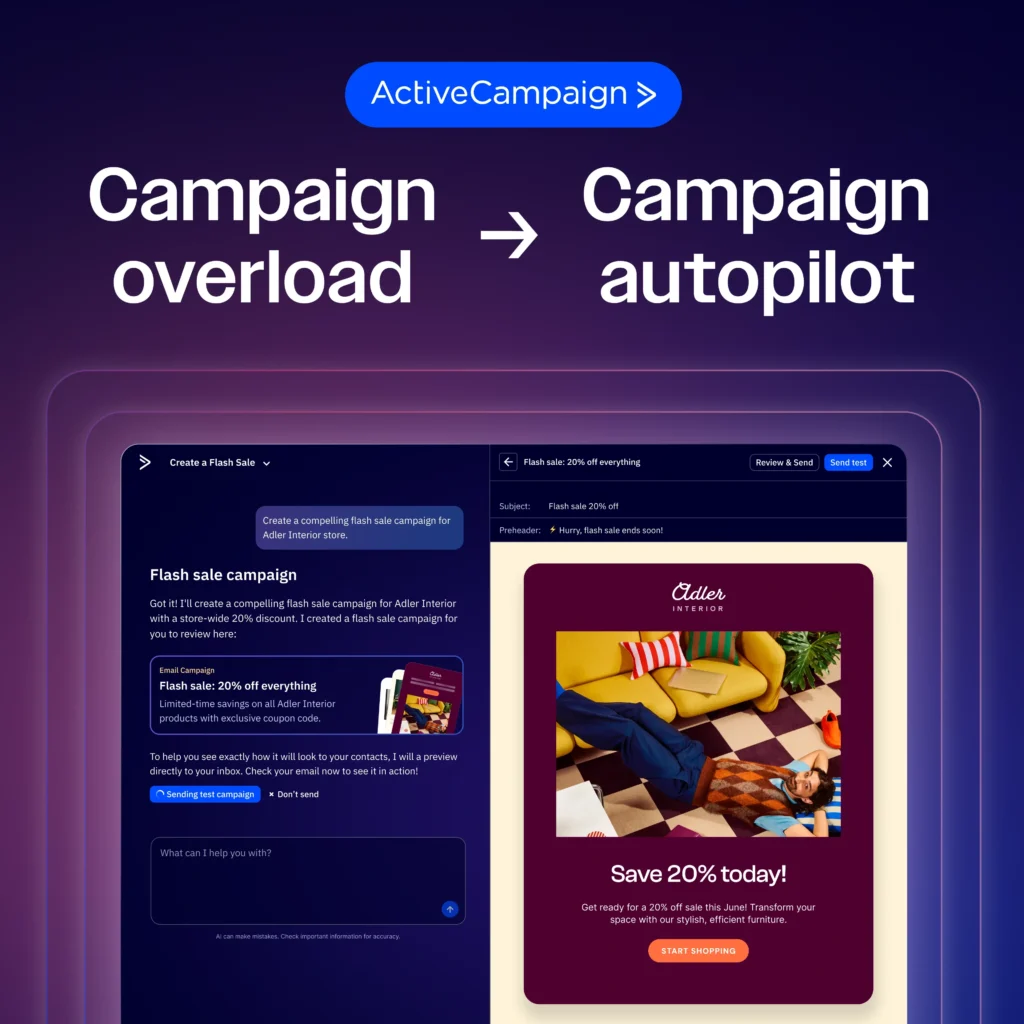
With autonomous marketing, plain language replaces workflow engineering. Using tools like the AI Campaign Builder, you can literally type a prompt such as: “Create a 3-part email series for our upcoming Spring Sale targeting past purchasers, offering a 20% discount.”
The AI will:
- Generate the copy for all three emails.
- Structure the timing between sends.
- Apply your company’s aesthetic using an AI Brand Kit (which pulls your brand identity directly from your URL).
- Readily assemble the automation flow for your approval.
You go from a raw idea to a ready-to-review campaign in seconds.
Pillar 2: Activate (Predictive Intelligence)
Traditional platforms focus on reporting past failures. They tell you after a campaign flopped that your open rates were low.
Autonomous marketing uses predictive intelligence to flag potential problems and capitalize on opportunities proactively. Predictive Sending is a prime example. Instead of blanketing your entire list with an email at 9:00 AM on Tuesday, Active Intelligence analyzes the historical behavior of every single contact on your list. It then individually delivers the email to each person at the exact hour they are statistically most likely to open it.
Pillar 3: Validate (Scalable Personalization)
Growth hits a ceiling when you have to manually analyze data. Autonomous platforms continuously validate your campaigns against billions of data points.
For instance, rather than manually hunting for customer trends, tools like AI-Suggested Segments automatically flag high-impact audiences. The platform might alert you: “We have identified 400 customers who are at high risk of churning this week. Would you like to launch a re-engagement campaign?” Every piece of customer data becomes immediately, effortlessly actionable.
4. Traditional Automation vs. Autonomous Marketing: A Direct Comparison
To make the distinction crystal clear, let’s look at how a standard marketing objective is handled under both models.
Scenario: You want to launch a re-engagement campaign for customers who haven’t purchased in 90 days.
| Feature / Task | Traditional Email Automation | Autonomous Marketing (Active Intelligence) |
| Data Discovery | You manually export data, use complex “If/Then” filters, and build a static segment. | AI-Suggested Segments automatically identifies the at-risk segment and suggests targeting them. |
| Content Creation | You stare at a blank screen, write copy, source images, and format the email block by block. | You provide a simple prompt to the AI Campaign Builder, which generates the full email, on-brand, in seconds. |
| Delivery Timing | You schedule the email for a generic time (e.g., Thursday at 10 AM) and hope for the best. | Predictive Sending delivers the email individually to each user at their optimal engagement time. |
| Optimization | You check reports a week later and run manual A/B tests to see what worked. | The platform continuously learns from real-time engagement and adapts the strategy to hit your specified business goals. |
5. Practical Examples: Autonomous Marketing in the Real World
How does this actually look when applied to a real business? Let’s look at three practical use cases that illustrate the power of autonomous marketing.
Use Case 1: The E-Commerce Holiday Rush
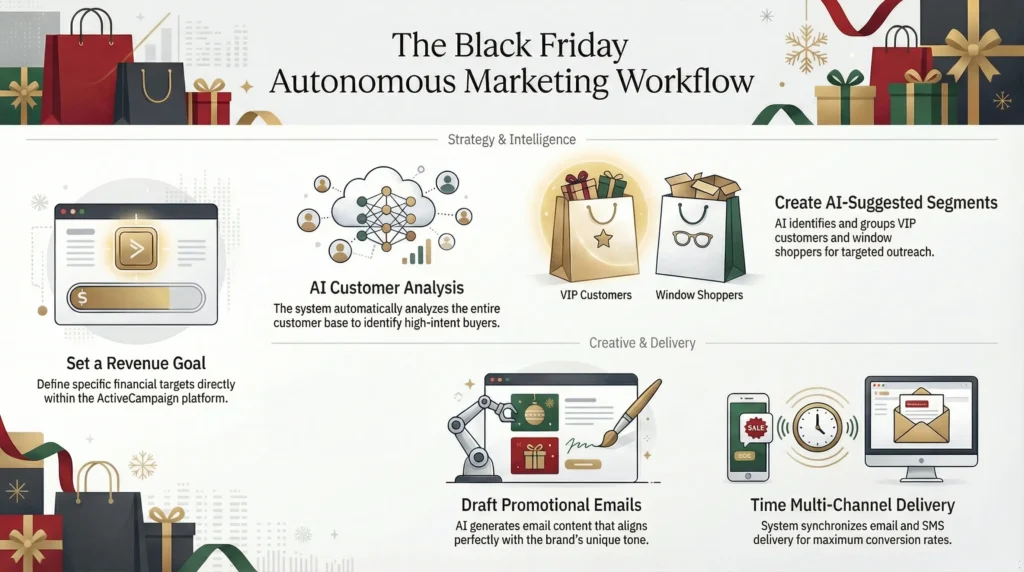
An e-commerce store owner is preparing for Black Friday. Traditionally, this required mapping out complex logic flows for VIP customers, window shoppers, and past purchasers. With autonomous marketing, the owner sets a specific revenue goal within ActiveCampaign. The AI analyzes the customer base, automatically creates an AI-Suggested Segment of high-intent buyers, drafts the promotional emails matching the brand’s tone, and perfectly times the delivery across email and SMS channels to maximize conversion rates.
Use Case 2: The B2B SaaS Nurture Sequence
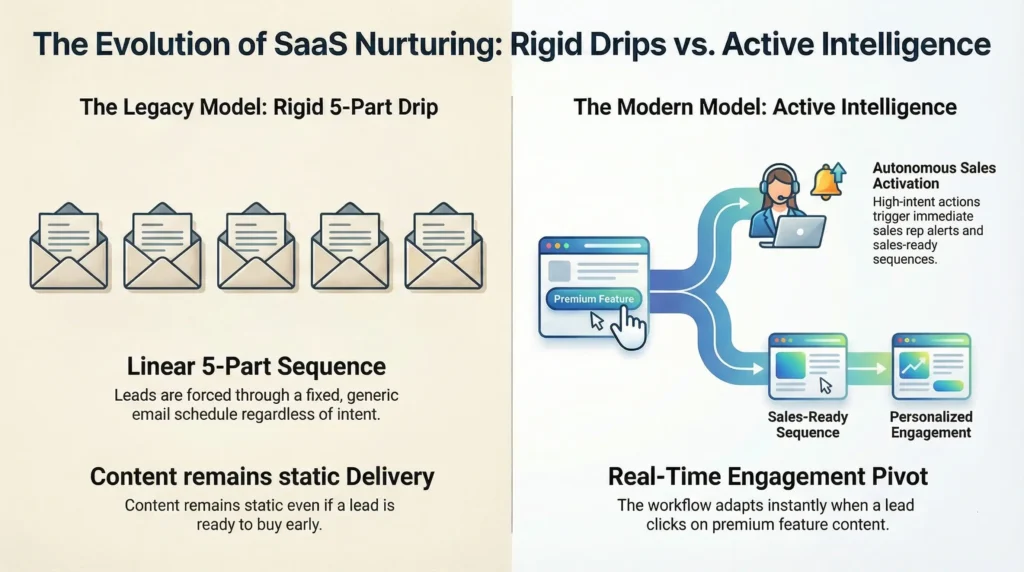
A B2B software company captures leads through a whitepaper download. Under the old model, these leads would receive a rigid 5-part email drip. With Active Intelligence, the workflow adapts based on real-time engagement. If a lead clicks a specific link about a premium feature in email two, the autonomous system recognizes this buying intent and immediately pivots the user into a sales-ready sequence, alerting a rep, rather than forcing them to finish the generic drip.
Use Case 3: The Creator Launching a Course
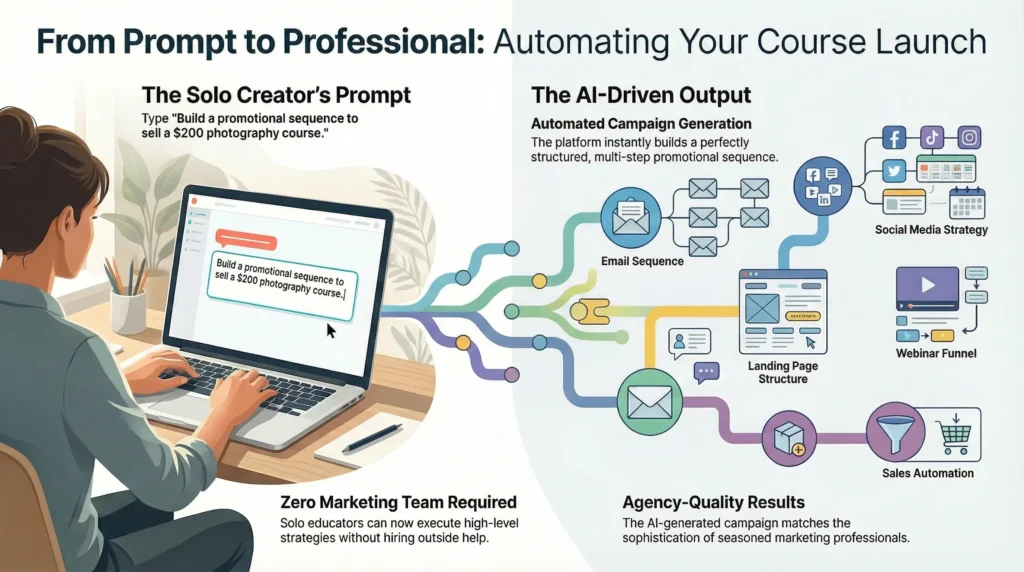
A freelance educator is launching a digital course but lacks a dedicated marketing team. Using the AI Automation Builder, they simply type: “Build a promotional sequence to sell a $200 photography course to my engaged newsletter subscribers.” The platform handles the heavy lifting, giving the creator a perfectly structured, sophisticated campaign that looks like it was built by a seasoned agency.
6. The Business Impact: Why You Need to Switch Now
The transition to autonomous marketing is not just about adopting a cool new tech feature; it is a fundamental shift in how businesses grow.
When you eliminate the manual friction of campaign testing, list building, and data analysis, the results are staggering. Businesses that leverage ActiveCampaign’s autonomous tools consistently report:
- Massive Time Savings: Customers frequently save over 10 hours a week by letting the AI handle campaign generation and segment discovery.
- Unmatched Deliverability: Because emails are highly targeted and predictively sent, engagement soars. ActiveCampaign boasts a 93.4% deliverability rate (the #1 in the industry), ensuring your messages actually hit the inbox.
- Higher Revenue Per Contact: Scalable, 1:1 personalization means customers receive exactly what they want, precisely when they want it, leading to dramatically higher lifetime values.
You are no longer an automation mechanic connecting wires. You return to being a strategic marketer.
FAQs
What exactly is autonomous marketing?
Autonomous marketing is a technology-driven approach where AI software proactively builds, executes, and optimizes marketing campaigns based on your overarching business goals, drastically reducing the need for manual, rule-based setup.
How does Active Intelligence differ from regular AI tools like ChatGPT?
Generic AI tools are trained on the broad internet to answer questions or generate raw text. Active Intelligence is deeply embedded into your marketing platform and is trained on billions of specific marketing interactions. It doesn’t just write text; it analyzes your real business data to execute campaigns and optimize for revenue.
Will I lose control over my marketing if it is “autonomous”?
No. Autonomous marketing acts as a highly intelligent co-pilot, not a rogue agent. It does the heavy lifting of surfacing data and building frameworks, but you maintain final approval. You can always refine, edit, and set strict boundaries before any campaign goes live.
Do I need to be a tech expert to use these AI agents?
Absolutely not. The primary benefit of autonomous marketing is simplicity. If you can type a plain-language sentence describing what you want to achieve, the platform translates that into the technical workflow for you.
Is autonomous marketing only for enterprise businesses?
No! While enterprise businesses certainly benefit from the scale, small businesses, creators, and solopreneurs actually see the most profound impact because it acts as the marketing team they don’t have the budget to hire.
Conclusion: Reclaiming Your Time and Scaling Your Growth
The era of spending 13 hours a week manually dragging and dropping workflow blocks, guessing at the best time to send an email, and staring blankly at performance dashboards is over.
Traditional email automation laid the groundwork, but it inherently limited your growth to how many rules you had the time to build. Autonomous marketing shatters that ceiling. By leveraging systems governed by Active Intelligence, you transition from merely sending emails to executing a dynamic, goal-driven strategy that learns and adapts in real-time.
Whether you need to instantly generate a cross-channel campaign from a simple prompt or rely on predictive data to find your most valuable customers, the technology is here, and it is accessible.
It is time to stop working for your marketing software and let your marketing software work for you.
Ready to experience the future of digital marketing?
Start your 14-day free trial of ActiveCampaign’s autonomous marketing platform today.