Over the past year, we’ve had more conversations with SEO teams about “missing traffic” than ranking drops. Keywords hold their positions. Pages still sit on page one. Yet impressions slide, clicks thin out, and reporting stops making sense.
In most cases, the answer sits above the results.
Google’s AI Overviews quietly absorb visibility that used to belong to organic listings. They quote some brands, ignore others, and reshuffle sources without touching classic rankings. If you’re not tracking those changes directly, you’re guessing why performance moves.
That’s why AI Overviews trackers have become part of our core SEO stack. Not as an experiment, but as a way to explain what traditional rank tracking no longer can. This article looks at how AI overview tracking tools work in practice and which platforms give SEO teams data they can actually use in 2026.
What are AI Overviews? And how do they impact SEO rankings?
Google’s AI Overviews generate synthesized answers at the top of search results. They combine content from multiple sources, reorder citations dynamically, and refresh independently from organic rankings. From a measurement standpoint, this breaks a long-standing assumption: a stable rank no longer guarantees stable visibility.
AI Overviews trackers exist to close that gap. Instead of focusing only on URL positions, AI Overview tracking tools monitor how generated answers behave, including:
- Whether a keyword triggers an AI Overview at all.
- Which domains are cited as sources inside the answer.
- How often do those sources rotate or disappear.
This data explains scenarios that classic rank tracking cannot, such as declining clicks while keyword positions remain unchanged.
For SEO teams, AI Overviews SEO rank tracking tools introduce three signals that now shape real exposure:
- Citation frequency: how often a brand or page appears across AI answers.
- Placement order: where citations appear within the generated response.
- Volatility over time: how stable or unstable those placements are.
Together, these signals influence brand visibility as much as page-one rankings, and in some cases more.
The Rise of AI Overview Tracking Tools
Early rank trackers treated AI answers as a SERP feature. That approach failed once AI snapshots began rotating sources daily. Manual checks and screenshots did not scale, especially across hundreds of keywords.
Modern AI Overview tracking software shifted to snapshot-based monitoring. These systems do the following:
- Store generated answers.
- Map cited domains.
- Log changes over time.
The result is historical visibility data that mirrors how AI results actually behave.
This shift also introduced new metrics. AI snapshot volatility tracks how often sources rotate for the same query. Generative search visibility tracking measures whether a brand appears consistently, intermittently, or not at all. Together, these metrics explain traffic changes that traditional rank tracking misses.
Feature Comparison: Best AI Overview Rank Tracking Tools
Before reviewing individual platforms, it helps to compare how leading tools approach AI Overview tracking. The table below outlines core capabilities that matter in 2026, from snapshot monitoring to volatility analysis.
| Tool | AI Snapshot Monitoring | Keyword Integration | Accuracy Signals | Pricing Model | Ideal For | Unique 2026 Feature |
| SE Ranking | Yes (stored answers) | Native project keywords | Daily refresh + history | Subscription + add-on | Agencies, in-house SEO | AI snapshot volatility trends |
| SEO PowerSuite | Partial | Manual keyword mapping | Periodic checks | Desktop license | Technical teams | Offline snapshot storage |
| Nightwatch | Yes | Cloud-based projects | Daily tracking | Subscription | Data-driven SEOs | Automated anomaly alerts |
| Nozzle | Yes | API-first | Raw SERP data | Usage-based | Large datasets | Granular citation parsing |
| Mangools | Limited | Keyword lists | Feature detection | Subscription | Small teams | Lightweight AI overview flags |
| AccuRanker | Partial | Fast keyword sync | High-frequency updates | Subscription | High-volume tracking | Speed-focused snapshot polling |
| SEOmonitor | Partial | Forecast-driven | Modeled estimates | Subscription | Strategic planning | Volatility forecasting |
| BrightEdge | Yes | Enterprise keywords | Modeled + sampled | Contract | Large organizations | Cross-channel AI reporting |
| ZipTie.dev | Yes | API-driven workflows | Structured answer parsing | Usage-based | Technical & product teams | Structured AI answer extraction |
This comparison highlights a key divide. Some platforms treat AI Overviews as a feature flag. Others store full answer snapshots and expose volatility data. The latter group aligns more closely with how AI answers affect visibility in practice.
In-Depth Reviews: Best AI Overview Trackers
SE Ranking: A Top AI Overview Tracker with Transparent Pricing
Snapshot Summary
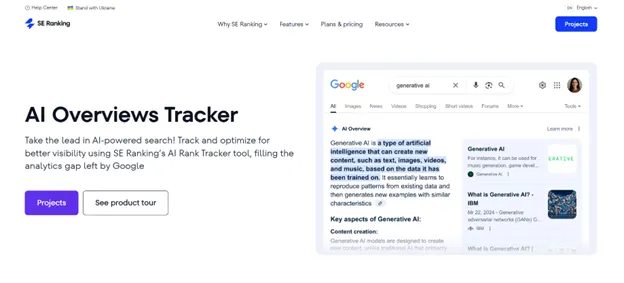
SE Ranking combines AI Overview tracking with traditional rank monitoring inside one workflow. Instead of isolating AI data, it connects Google AI Overview visibility with keyword rankings, competitors, and historical trends. This approach helps explain performance changes that rankings alone cannot clarify.
Core AI Tracking Capabilities
SE Ranking’s AI Overviews Tracker is part of its AI Search Toolkit. It detects which keywords trigger AI Overviews, tracks brand mentions and linked sources, and stores historical snapshots. Daily updates make it possible to measure AI snapshot volatility and identify when citations rotate or disappear.
Who It’s Best For
SEO teams at agencies and in-house departments that want an AI Overview tracking without managing separate tools or datasets.
Integration Ecosystem
AI Overview data integrates with SE Ranking’s rank tracker, keyword research, competitive analysis, reporting, and API access. This allows AI visibility signals to sit alongside traditional SEO metrics in one system.
Pricing Plans
- Core: $103.20/month with an annual 20% subscription
- Growth: $233.20/month with an annual 20% subscription
- AI-search add-on from $71.20/month (depending on the number of prompts)
- 14-day free trial available
Pros and Cons
- AI Overview tracking included within a full SEO platform.
- Daily updates with historical AI snapshot data.
- 20% savings on annual subscriptions.
- 14-day free trial without commitment.
- Advanced AI features require higher-tier plans.
- Learning curve for teams new to AI visibility metrics.
Verdict
SE Ranking fits teams that want a practical AI Overview tracker tied directly to ranking, competitor, and reporting workflows. Its transparent pricing and annual discount lower entry barriers while supporting long-term generative search visibility tracking.
SEO PowerSuite: Integrated AI Overview Rank Tracking
Snapshot Summary
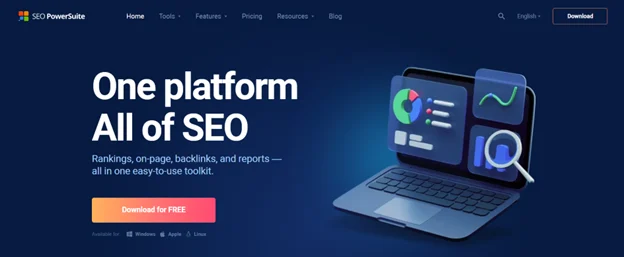
SEO PowerSuite approaches AI Overview tracking through a desktop-based workflow. It detects whether AI Overviews appear for tracked keywords and ties that information to classic ranking data, keeping AI visibility analysis close to traditional SEO metrics.
Core AI Tracking Capabilities
The platform flags AI Overview presence at the keyword level and records changes over time. Instead of storing full AI answers, it focuses on correlating Overview appearance with rank and SERP feature shifts. This makes it easier to spot patterns but limits citation-level insight.
Who It’s Best For
Technical SEO teams that already rely on desktop tooling and prefer local data storage over cloud dashboards.
Integration Ecosystem
SEO PowerSuite connects AI Overview signals with rank tracking, audits, and backlink analysis inside the same environment.
Pricing Plans
- Professional: $29.10/month–$60/month equivalent billed annually
- Growth (Enterprise): ~$49.95/month–$140/month equivalent billed annually
- AI-search add-on (included AI Overview/monitoring in full versions)
- Free version available with limited features
Pros and Cons
- Strong for rank correlation and offline workflows.
- Limited depth for AI snapshot analysis.
Verdict
Best used as a hybrid rank-first solution.
Nightwatch: Automated AI Snapshot Tracking Tool
Snapshot Summary
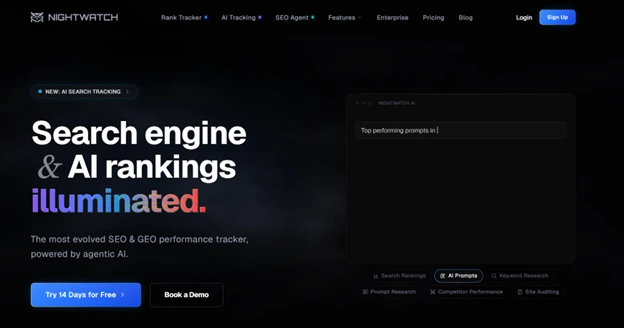
Nightwatch positions itself as a fast, automation-focused AI Overview tracker. It monitors when AI Overviews appear and how visibility changes across keyword sets, with an emphasis on daily updates.
Core AI Tracking Capabilities
The tool tracks AI snapshot presence, logs changes over time, and surfaces anomalies when visibility shifts unexpectedly. While it does not deeply parse citation text, it excels at detecting volatility signals tied to AI results.
Who It’s Best For
SEO teams that manage large keyword portfolios and need early warnings when AI answers start affecting exposure.
Integration Ecosystem
Nightwatch integrates AI Overview data with cloud-based rank tracking and reporting workflows.
Pricing Plans
- The entry price is $39/month
- AI-search add-on pricing varies by prompt volume
Pros and Cons
- Reliable automation and speed.
- Lighter insight into citation placement.
Verdict
A solid choice for monitoring AI-driven volatility at scale.
Nozzle: Deep Data AI Overview Analytics
Snapshot Summary
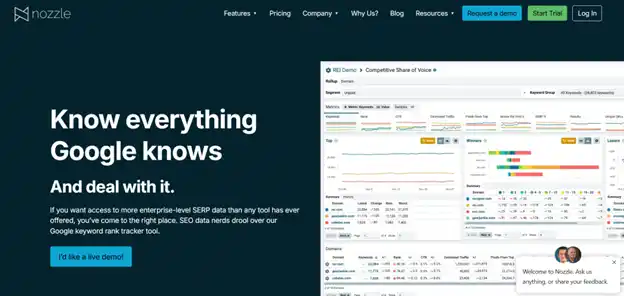
Nozzle treats AI Overviews as a data problem. Its approach centers on capturing granular SERP snapshots and exposing how generated answers interact with organic results at scale. The platform emphasizes raw visibility signals over simplified summaries.
Core AI Tracking Capabilities
Nozzle records AI Overview appearances alongside full SERP data, including source domains and structural changes. While it does not position itself as a plug-and-play AI Overview tracker, its dataset supports advanced analysis of citation patterns and AI snapshot volatility through custom views.
Who It’s Best For
SEO teams with strong data skills that want full control over how AI visibility metrics are modeled and interpreted.
Integration Ecosystem
Nozzle offers API access and flexible exports designed for internal dashboards and external BI tools.
Pricing Plans
- Subscription starts at the standard entry of $59/month
- Usage-based higher plan with more SERP data capacity
- AI-search add-on built into main offering (contact for volume pricing)
Pros and Cons
- High-resolution SERP and AI snapshot data.
- Flexible modeling for custom analysis.
- Steeper learning curve.
- Limited out-of-the-box AI Overview summaries.
Verdict
A strong choice for teams that value raw data depth over presets.
Mangools: Simple Interface with AI Overview Add-Ons
Snapshot Summary
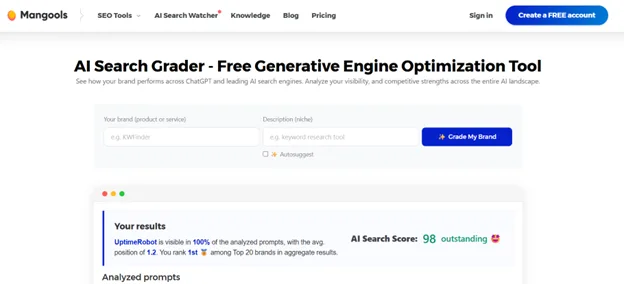
Mangools approaches AI Overviews as an extension of classic rank tracking. Its tools flag when AI answers appear and surface that context inside an interface built for speed and clarity.
Core AI Tracking Capabilities
The platform identifies keywords that trigger AI Overviews and associates them with ranking data. It does not store full AI snapshots or citation histories, but it gives teams a quick way to see where AI results intersect with tracked queries.
Who It’s Best For
Small SEO teams and agencies that want a lightweight AI Overview tracking without added complexity.
Integration Ecosystem
Mangools connects AI Overview indicators with keyword tracking and SERP analysis inside its existing toolset.
Pricing Plans
- Basic package: $30.50/month
- Premium package: $40.50/month
- Agency: $70.50/month
- AI-search add-ons included in AI Search Watcher & AI Search Grader tools
- Free mini SEO tools available; no dedicated traditional free trial, but a money-back guarantee
Pros and Cons
- Clear interface and fast setup.
- Useful for early AI Overview detection.
- Limited citation and volatility data.
- No deep generative search analysis.
Verdict
Best suited for teams that need awareness rather than a deep AI Overview analysis.
AccuRanker: Scalable AI Overview Rank Tracking Software
Snapshot Summary
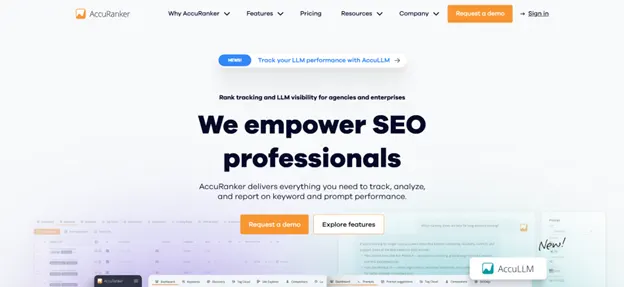
AccuRanker extends its high-frequency rank tracking model to AI Overviews by focusing on speed and scale. The platform prioritizes fast data refreshes to show when AI answers begin affecting keyword visibility.
Core AI Tracking Capabilities
AccuRanker detects whether tracked keywords trigger AI Overviews and aligns those signals with daily ranking updates. While it does not archive full AI answer texts, it highlights correlations between rank movement and AI presence, which helps teams spot early impact patterns.
Who It’s Best For
SEO teams managing large keyword sets that need rapid updates and a consistent tracking cadence.
Integration Ecosystem
The tool integrates AI Overview indicators into its existing dashboards, exports, and API connections used for rank reporting.
Pricing Plans
- Professional from €224/month (annual billed with ~10% discount)
- Expert from €764/month
- AI-search add-on (LLM Lite / Pro pricing tiers available starting ~$229/month for AI prompt tracking)
Pros and Cons
- Very fast data refresh rates.
- Scales well for large keyword portfolios.
- Limited insight into citation placement.
- No detailed AI snapshot history.
Verdict
A practical option for teams that value speed over deep AI answer analysis.
SEOmonitor: Forecasting AI Overview Volatility
Snapshot Summary
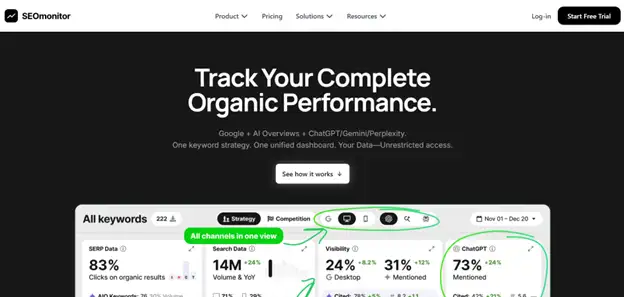
SEOmonitor approaches AI Overviews through forecasting and planning. It treats AI visibility as a variable that can influence expected performance rather than a static ranking factor.
Core AI Tracking Capabilities
The tool identifies AI Overview presence and incorporates those signals into its forecasting models. While it does not store full AI answers, it highlights volatility patterns that affect expected traffic and performance scenarios.
Who It’s Best For
SEO teams focused on forecasting, budgeting, and scenario planning influenced by AI-driven SERP changes.
Integration Ecosystem
SEOmonitor connects AI Overview indicators with forecasting, rank tracking, and planning dashboards.
Pricing Plans
- Starter from €99/month (based on keyword bundle pricing)
- Pro from €299/month with expanded keyword & AI content tracking
- AI-search add-ons available (optional add-ons for AI tracking features)
- 14-day free trial available
Pros and Cons
- Useful for modeling AI-driven volatility.
- Strong planning and forecasting context.
- Limited direct AI snapshot visibility.
- Less suited for citation-level analysis.
Verdict
A good fit for teams that need to anticipate AI impact rather than audit answers in detail.
BrightEdge: Enterprise-Level AI Overview Analysis
Snapshot Summary
BrightEdge positions AI Overviews within an enterprise SEO measurement framework. Its focus stays on connecting AI-driven exposure to broader visibility and performance metrics rather than inspecting individual answers in isolation.
Core AI Tracking Capabilities
The platform detects AI Overview presence for tracked keywords and incorporates that data into visibility models used across search and content reporting. BrightEdge emphasizes trend consistency and share-of-voice signals over granular citation tracking, which aligns with large-scale reporting needs.
Who It’s Best For
Large organizations with established SEO operations that need AI Overview insights aligned with executive reporting and cross-channel measurement.
Integration Ecosystem
BrightEdge integrates AI Overview data into its enterprise dashboards, content workflows, and performance reporting systems.
Pricing Plans
- Entry is typically a custom-quoted enterprise suite
- Expanded enterprise suite with visibility analytics
- AI-search add-on integrated into the platform (pricing provided via sales)
- Free trial/demo available upon request
Pros and Cons
- Enterprise-ready reporting and governance.
- Strong alignment with strategic visibility metrics.
- Limited access to raw AI snapshot data.
- Less flexible for hands-on citation analysis.
Verdict
Best suited for enterprises prioritizing high-level AI visibility insights over tactical diagnostics.
ZipTie.dev: Structured AI Answer Monitoring for Technical Teams
Snapshot Summary
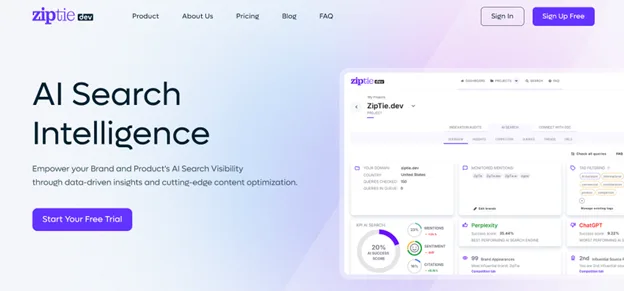
ZipTie.dev approaches AI Overview tracking as a structured data extraction challenge. Rather than presenting simplified dashboards, it captures AI-generated answers and parses them into structured, machine-readable formats. This enables technical teams to build custom AI visibility models and automate monitoring pipelines.
Core AI Tracking Capabilities
ZipTie.dev detects AI Overview triggers and extracts cited domains, structural answer components, and entity references. It stores historical versions of generated answers, making it possible to measure AI snapshot volatility at a granular level.
Unlike tools focused on visualization, ZipTie.dev prioritizes API-driven workflows, enabling teams to ingest AI Overview data directly into internal systems.
Who It’s Best For
Technical SEO teams, product teams, and organizations that want raw AI Overview data integrated into custom dashboards or proprietary analytics stacks.
Integration Ecosystem
ZipTie.dev is API-first, offering flexible endpoints for exporting AI snapshot data into BI tools, internal monitoring systems, or product intelligence workflows.
Pricing Plans
- Basic: $69/month for 500 AI searches (Google AI Overviews, ChatGPT, Perplexity)
- Standard: $99/month for 1,000 AI searches
- AI-search add-ons: Pro: $159/month for 2,000 AI searches
Pros and Cons
- Highly structured AI answer parsing.
- API-first flexibility for custom analytics.
- Supports granular volatility measurement.
- Minimal out-of-the-box visualization.
- Requires technical resources for full utilization.
Verdict
ZipTie.dev is ideal for teams that want full control over AI Overview tracking data and prefer building their own visibility models rather than relying on preset dashboards.
AI Overview Tracking Insights: What are the key 2026 trends and predictions?
By 2026, AI Overviews function as a dynamic answer layer rather than a static SERP feature. Tracking data across tools shows several patterns that now affect most industries.
Key trends shaping AI Overview tracking:
- Rising AI snapshot volatility
For many non-branded queries, cited sources rotate frequently, even when organic rankings remain stable. This makes weekly checks unreliable and increases the need for daily AI Overview monitoring. - Shift toward automation and APIs
Leading AI Overview tracking software now exposes visibility data through APIs. Teams feed generative search visibility tracking into internal dashboards alongside traffic and conversion metrics. - Cross-platform AI visibility overlap
Pages cited consistently in Google AI Overviews often appear in AI Mode and other LLM answers. AI Overview analysis tools increasingly act as early indicators of broader generative search performance.
These trends explain why AI Overview tracking tools now support ongoing diagnostics, not just periodic reporting. They surface exposure changes that traditional rank tracking does not capture.
How do brands adapt to AI Overview rankings? (case insight)
One B2B SaaS brand we analyzed saw a 22% drop in non-branded clicks despite stable top-five rankings. AI Overview tracking revealed the cause: their core comparison keywords triggered AI Overviews that stopped citing their domain.
Using an AI overviews SEO rank tracking tool, the team identified which competitors replaced them as sources. The common factor was clearer definitions and structured explanations, not higher rankings. They adjusted content format, added concise summaries, and improved entity coverage.
Within six weeks, the brand regained consistent citations across tracked queries. Rankings barely moved, but impressions recovered. This case illustrates why AI Overview trackers matter. They surface visibility losses that rankings hide and point directly to the changes needed to regain exposure.
FAQs About AI Overview Trackers
How do AI Overview tracking tools measure AI visibility changes?
AI Overview tracking tools monitor whether a query triggers an AI Overview, which sources appear inside the answer, and how those sources change over time. Instead of relying on URL positions, they track citation presence, placement order, and frequency. This approach explains visibility shifts that occur without ranking changes.
What’s the most accurate AI Overview tracker in 2026?
Accuracy depends on data freshness and snapshot depth. The best AI overviews rank tracking software stores full AI answer snapshots, refresh data daily, and provides historical comparisons. Tools that only flag AI Overview presence without storing answers tend to miss volatility patterns.
Can AI Overview rank tracking tools replace SEO rank tracking software?
No. AI Overview tracking tools complement, not replace, traditional rank tracking. Rankings still matter for crawlability and baseline visibility. A strong workflow combines classic rank data with a Google AI Overview tracker to understand how exposure shifts across both layers.
Conclusion: Future-Proof Your SEO
AI Overviews changed what visibility means. Rankings still matter, but they no longer tell the full story. Brands gain and lose exposure inside generated answers that update independently from organic results.
That shift makes AI Overviews trackers essential infrastructure for SEO teams in 2026. The best AI overviews tracking tools surface citation patterns, volatility signals, and generative search visibility tracking data that rankings cannot explain on their own.
Teams that adapt early stop guessing why performance moves. They measure it directly, act faster, and align content with how AI systems actually surface sources. In a search environment shaped by generated answers, that clarity becomes a competitive advantage.